How Should Loafers Fit? A Simple Guide to Sizing, Heel Slip and Breaking In (2026)
So, how should loafers fit? They should feel snug across the widest part of your foot without any pain, with a little room in front of your toes and only a slight lift at the heel when you walk. Loafers stretch a little in width but not in length, so if you fall between two sizes, choose the smaller one.
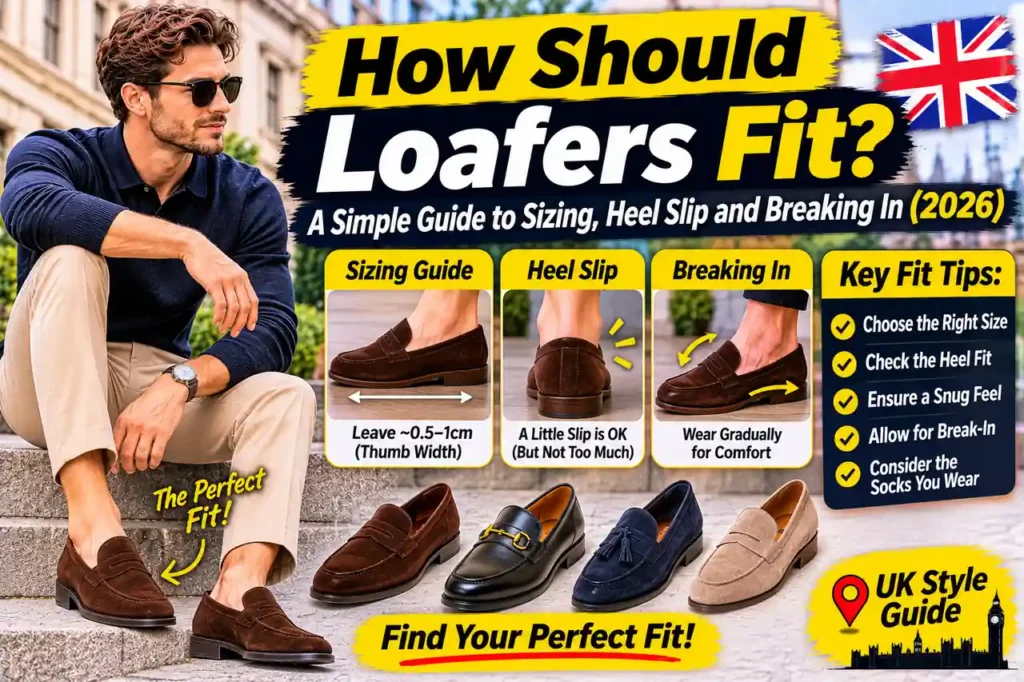
Loafers are one of the easiest shoes to wear, but they are also one of the easiest to get wrong. Buy them too big and they slip off with every step. Buy them too small and they pinch all day. Getting the size right is the single most important part of how to wear loafers well.
This guide answers the question “how should loafers fit?” in plain English. You will learn seven easy checks, how to measure your feet at home, whether to size down, and what to do if your loafers feel too big or too small. For a second view, the Stridewise guide on how loafers should fit is also worth a read.
Why fit matters more with loafers
Most shoes have laces. If they feel a bit loose, you pull the laces tighter. Loafers have no laces, no buckles and no straps to adjust. The only thing holding the shoe on your foot is the fit itself.
That is why the question of how should loafers fit matters so much. A pair that is just half a size too big will slip at the heel, rub, and feel sloppy. A pair that fits well feels like a slipper that stays put.
How should loafers fit? The quick checklist
Here is how should loafers fit at each part of your foot, in one simple table.
| Part of the foot | How it should feel | Warning sign |
|---|---|---|
| Top of the foot | Snug, a gentle hug | Pressing hard, or a gap you can slide a finger into |
| Toes | A little room, toes can wiggle | Toes touching the end |
| Heel | Only a slight lift as you walk | Heel coming right out of the shoe |
| Sides (width) | Close but not squeezed | Sharp pressure on the little toe or big toe joint |
| Overall | Comfortable from the first wear | Pain, numbness or rubbing that makes you limp |
7 easy checks for the perfect loafer fit
Try your loafers on at home, on a carpet or a clean floor, and run through these seven checks.
1. How should loafers fit across the top?
The top of the foot, called the instep, is where a loafer grips you. It should feel like a firm, gentle hug. Loafers should feel snug, not tight, across the widest part of the foot on day one. maisonvalre.store
If you can slide a finger easily between the top of your foot and the shoe, the loafer is too big.
2. How should loafers fit at the toe?
Your toes should have a little room to wiggle, and they should not touch the end of the shoe when you stand. As a rough guide, there should be a small gap of around a finger’s width at the front.
This is the most important check, because loafers stretch over time but not in length. If your toes touch the end now, they always will. stridewise
3. How should loafers fit at the heel?
A little heel lift is normal in a new pair, because the sole is still firm and has not yet learned the way your foot bends. As the sole flexes, this lift gets smaller.
What is not normal is your heel coming right out of the shoe. Your heel should not slide completely out while walking. If it does, the loafer is too big. stridewise
4. How should loafers fit at the sides?
The shoe should hold the sides of your foot without squeezing. Watch for sharp pressure on the joint of your big toe or the outside of your little toe. Mild snugness will ease as the leather softens, but pain will not.
5. Do the walk test
Walk around the room for a few minutes. The shoe should move with your foot, not flap behind it. You should not need to grip with your toes to keep the loafer on.
6. Do the sock test
Try your loafers on with the socks you plan to wear. A thick sock and an invisible sock can feel like a different size. More on this below.
7. Try them in the afternoon
Feet swell a little during the day. A loafer that feels perfect at 9am may pinch by 5pm. Trying shoes on later in the day gives you a truer picture.
Should you size down in loafers?
This is one of the most common questions about how should loafers fit, and the honest answer is: it depends on the brand and the leather.
Many people find that their usual size in a lace up shoe feels a little loose in a loafer, and some size down by half a size. Others find their normal size is right. Simon Crompton of Permanent Style explains that an unlined loafer is made on the same last as a lined shoe, so the space inside is the same, and his advice is to get the same size in an unlined shoe as a lined one. You can read his full answer in his piece on questions about unlined loafers. permanentstyle
For our shoes, the advice is simple. Choose your usual EU size. If you fall between sizes, choose the smaller one, because unlined suede stretches slightly with wear. Boots and trainers fit true to size. maisonvalre.storemaisonvalre.store
How to measure your feet at home
If you are not sure of your size, measure your feet. It takes two minutes. Our size guide suggests these steps:
- Measure in the afternoon, wearing the socks you’ll wear with the shoes. maisonvalre.store
- Stand on paper and mark your longest toe and heel. maisonvalre.store
- Measure the distance in cm and choose the nearest foot length above it in the chart. maisonvalre.store
Measure both feet. Most people have one foot slightly bigger than the other, so go by the larger one. Our shoes are sized in EU sizes. As a guide, EU 38 is about a UK 5 and EU 46 is about a UK 11, and the size guide converts every size in between. maisonvalre.store
How should loafers fit when they are new?
A new pair of loafers should feel comfortable from the first wear, but a little snug. That snugness is a good sign, because the leather will soften and shape to your foot.
How much it gives depends on how the shoe is made. A fully lined loafer has two layers of leather and can feel stiff for weeks. An unlined loafer has just one, so it softens much faster. Unlined suede gives and moulds to your foot within the first few wears. Our Sagan Classic Loafers (£490) and Stride Loafers (£420) are both unlined for this reason. Read our guide to unlined vs lined loafers to learn more. maisonvalre.store
One rule to remember: snug is fine, pain is not. If a loafer hurts after a few wears, it is the wrong size, not a break in problem.
How should loafers fit with or without socks?
How should loafers fit if you plan to wear them with socks one day and without the next? Choose the size for the way you will wear them most.
- If you mostly go sockless, or wear invisible socks, the fit can be a touch snugger. Our Sagan Invisible Socks (£25) are thin, so they barely change the fit.
- If you mostly wear socks, try your loafers on with them. Our Cotton Socks (£25) are a fine weight that suits loafers.
- In winter, a slightly thicker sock can take up a little space in a pair that has stretched.
Our guide on loafers with or without socks explains when to choose each.
How should loafers fit for women?
The same rules apply. Women’s loafers should be snug across the top, with a little room at the toe and only a slight heel lift. Lighter, softer styles like the Sagan Bow in Albâtre Asteria Suede (£490) and the Sagan Classic Loafers in Obsidian Black Asteria Suede (£490) mould to the foot quickly.
So how should loafers fit if you plan to wear them with bare feet in summer? Choose a snug fit, as your foot has no sock to fill the space. Our guide on how to wear loafers for women has outfit ideas for every season.
Do suede and calf loafers fit differently?
Yes, a little. Soft suede usually gives a little more than smooth calf leather, and patent leather gives the least of all. So a calf loafer like the Berkeley Penny Loafers in Black Calf (£570) should feel comfortable on day one, not tight, because it will not stretch as much.
The same goes for evening shoes. Patent styles like the Sagan Bow in Black Soft Patent (£590) should fit comfortably from the start. Read our guide to suede vs leather shoes for more on how each material behaves.
Loafers too big? 5 easy fixes
If your loafers slip at the heel or feel loose across the top:
- Wear a slightly thicker sock. It fills the space and adds grip.
- Add a heel grip. A small pad stuck inside the back of the shoe stops your heel sliding.
- Add a tongue pad. A pad under the top of the shoe pushes your foot back into the heel.
- Give it a few wears. A stiff new sole can cause heel lift that settles down.
- Exchange for the smaller size. If your heel comes right out, the shoe is simply too big.
Loafers too tight? 4 easy fixes
If your loafers pinch:
- Wear them at home first. An hour or two at a time, with thin socks, helps unlined suede mould to your foot.
- Check the length. If your toes touch the end, the shoe is too short. Length does not stretch, so you need the next size up.
- Ask a cobbler about stretching. A cobbler can gently stretch the width of a leather shoe.
- Do not force it. If it still hurts after a few wears, exchange it.
What if you have wide or narrow feet?
Our lasts come in whole EU sizes, medium width only. For a made to measure pair, book a fitting. maisonvalre.store
If you have very wide or very narrow feet, the best thing to do is book a free fitting. It is a one on one session with a member of the team, by video call or in person at the atelier, lasting thirty minutes and free, with no obligation to buy. The team takes your measurements, talks through how you plan to wear the shoes and helps you choose the shape, leather and size. maisonvalre.store
Free exchanges if the size is wrong
Even with the best advice, sometimes the size is not right. That is fine.
- You get one free exchange per order, and the new size is reserved as soon as you request it. maisonvalre.store
- You have 30 days from delivery to return a pair, as long as the shoes are unworn and in their original box. maisonvalre.store
- Refunds are made within five working days of the return reaching us, to your original payment method. maisonvalre.store
So try your new pair on indoors, on a clean floor, before you wear them outside. That way you can still exchange them if they do not fit. Full details are on our exchanges and returns page.
Common loafer fit mistakes
- Buying a size up “to be safe”. A loose loafer will only get looser.
- Ignoring toe room. Loafers stretch in width, not in length.
- Trying them on in the morning. Your feet are smaller then than later in the day.
- Testing with the wrong socks. Always try them with the socks you will wear.
- Wearing them outside before you are sure. Worn shoes cannot be returned.
- Expecting pain to go away. Snug softens; pain means the wrong size.
The bottom line
How should loafers fit? Snug across the top, with a little room at the toe, only a slight lift at the heel and no pain anywhere. Remember that loafers stretch in width but not in length, so if you are between sizes, go for the smaller one. Measure your feet in the afternoon, try your shoes on with the right socks, and use a free fitting if you are not sure.
Once you have the fit right, you are ready to style them. Read our full guide on how to wear loafers, or browse our men’s loafers and women’s loafers.
Frequently asked questions
How should loafers fit when you first buy them?
Snug across the top of the foot, with a little room at the toe and a slight heel lift that settles as the sole softens. They should feel comfortable, never painful.
How much heel slip is normal in loafers?
A small lift at the heel is normal in a new pair. If your heel slides right out of the shoe when you walk, the loafer is too big.
Should loafers be tight at first?
Snug, yes. Tight, no. A good pair hugs your foot from day one and softens over the first few wears. Pain is a sign of the wrong size.
Do loafers stretch?
Yes, in width, especially unlined suede. They do not stretch in length, so your toes should never touch the end.
Should I size down in loafers?
Start with your usual size. If you fall between two sizes, choose the smaller one, as suede gives a little with wear.
How should loafers fit with socks?
Try them on with the socks you will wear most. Fine cotton socks change the fit only a little, while thick socks can make a loafer feel a size smaller.


